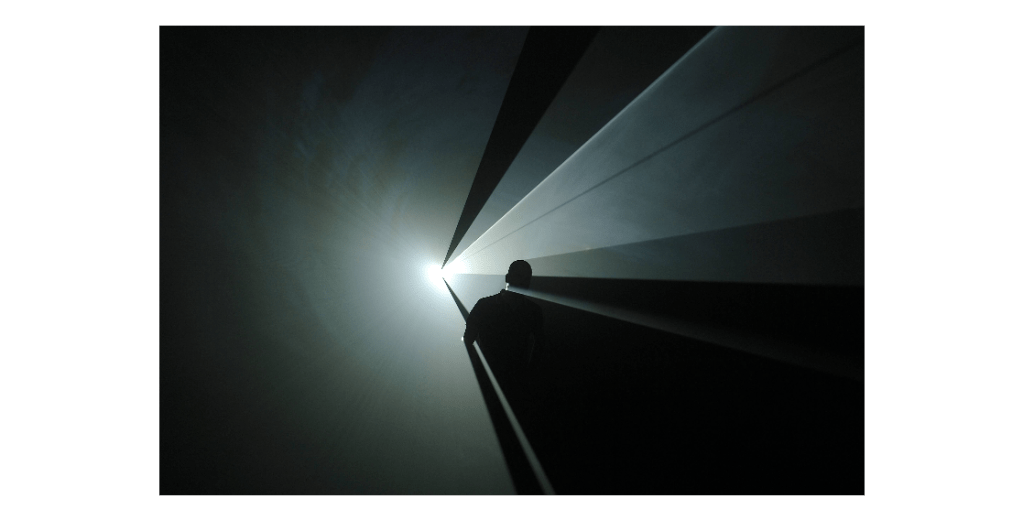
Encompasses one point perspective in a blank, greyish space. The darker shapes enable a bright fading-to-black transparency included in this artwork. The artwork itself already has a strong diagonal handle, which is stronger the more an eye is directed towards it’s brightest spot, which constitutes as a focal point. Figure and Ground applies with a human silhouette near the center of the artwork. Use of transparency applies when noting the white lighting fading into the darkness of the figure’s background.
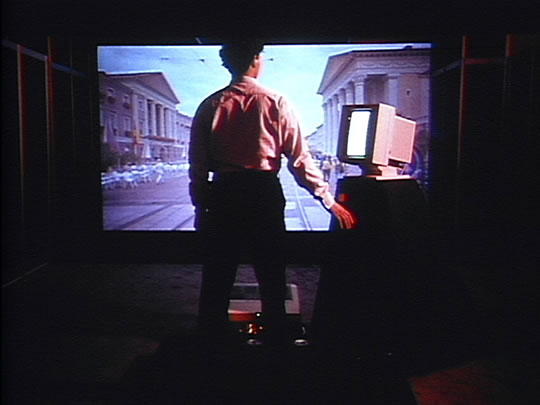
Scale shift lightly applies as the simulated projector/screen appears smaller than the human figure in front of it. The dark, opaque background bounds the rest of the image into a single room, creating an atmospheric perspective similar to a theatre.
Project 2 was undeniably a more enjoyable project- our graphic designs enabled me to make stepping stones of the massive scale of ideas I want to visualise and make! I had a lot of fun using graphic !
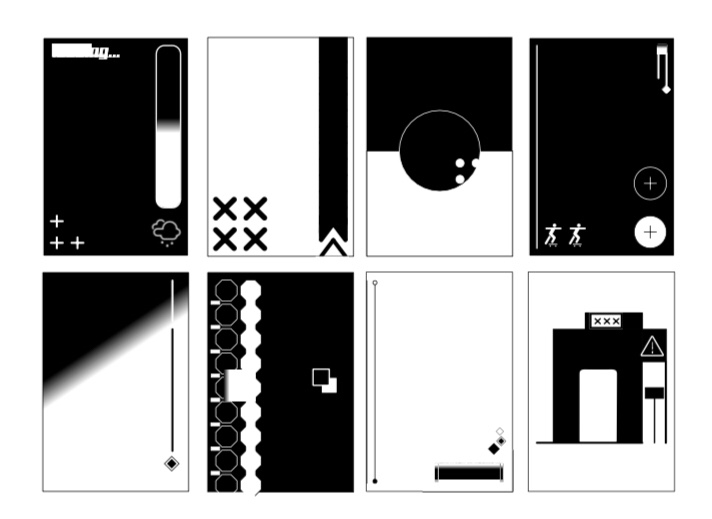
Unity and variety can make or break a successful design or composition. It’s harder when exploring nitty details, like whether to use 6-sided or 8-sided shapes for a graphic design, or choosing which colors are more suited when juxtaposed together. The larger and more inviting components include figuring out where to put shapes and lines across a page. Unity can occur when grouping similar or aesthetically pleasing objects together. Variety may happen in differentiating the number, size, shape, and color of the objects chosen in a piece. The amount of details can go on.
I thought about a lot of ways I can put a line next to a series of geometric shapes — diamonds, octagons, squares — this is my favorite pattern to explore with! When I read “Variety” I think of the number of times I used a shape other than a square or rectangle, and realize my shapes are becoming more fluid and abstract. I do enjoy the small narratives included in some of my designs, such as my inkwash, which is referenced by a song made an unnamed music composer who prefers to be unnamed. The story itself is very dark, and I find those elements fascinating enough to graph digitally.
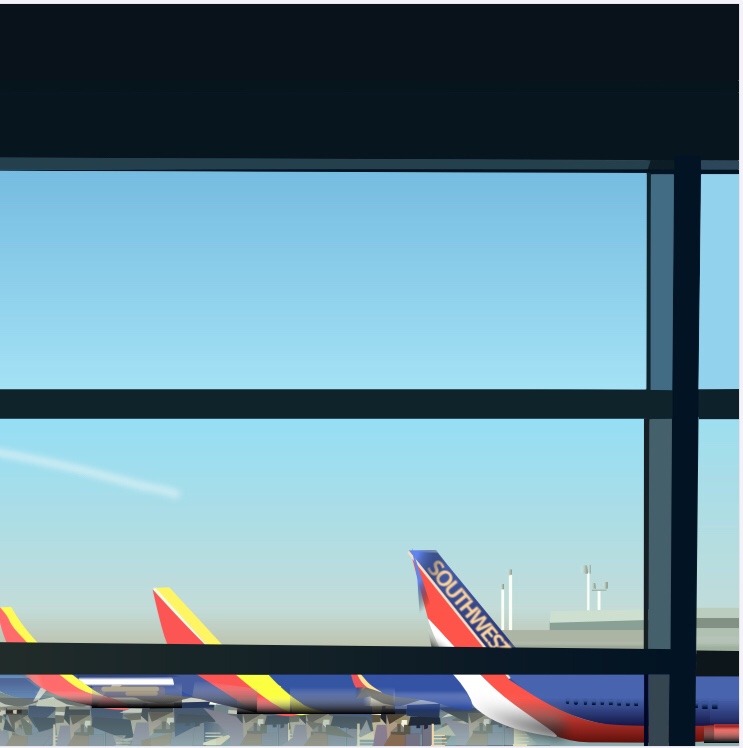
Our digital render was a definite push in time consumption and learning how to effectively use the line, fill, gradient, and pen tools in Graphic for IPad. The photo I chose has a lot of personal context (one of my first rides on a plane) and I hoped for the rendering to be not incredibly difficult. I didn’t take the myriad of tiny details at the very bottom of the photo to account, and this accumulated most of my spent on this project.
02 is an eyeopening process to explore the many creative tools I have available, and I look forward to our upcoming projects with Graphic.
———
Unrelated to 02 recap, but I feel I should include as detail.
I transferred out of STEM, with a rocky disconnect and lack of interest of going back. I don’t think I have much else room for somewhere else. There’s so much I want to do here, and yet…
The circumstances for this month’s recap feels unpredictable, knowing my absence and therefore inability to write an accurate 02 recap. It’s bizarre to know how my work and standing, everything would be perfectly fine by a difference of two hours of sleep…
“I could be fine, I could’ve been fine, I could be fine, I could’ve been fine—” There is nothing to say, but I have lots to uselessly ramble about, and a few scary options I briefly considered doing out of fear… I’m glad I didn’t.
I dislike my body. It never does exactly what I request of it, which isn’t a lot. I dislike like how most of it is filled with incapability, fueled by irresponsibility, and the fact I have yet to be properly and thoroughly vulnerable with myself.
I don’t think I’ve cried this much in a while. It’s been a bit too long since then… maybe late last semester? This entire response feels immature to write, but my ducts continue to moisten and burn by the second, and I’ll eventually realize that’s okay.
I need to take care of myself more, before things become too late again, and/or I’ll no longer have a body to take care of.
My favorite artist passed away this February, and the rain on my boots feel a little lighter each morning. Regularly waking at 8 am is a bit of a startling process, but I’m learning to adjust (and hopefully my body does the same).
Walking in this month’s Gestalt walk feels moist and foggy. I don’t have an umbrella, so the puddles soaking beneath my feet feel twice as real. Qunni loved drawing skies, yellow stars and blue rain. So the air feels twice as moist, my reflections are twice as bright, and yellow-green streetlights stretch and dance within their enclosed puddles.
Our gestalt walk reminds me of downtown Chicago and the infinite saturated puddles, lakes, dips and corners I was unable to count. Graffiti splays itself across nearly every building, and my ears vrum under the shaking bars of an overhead CTA train. My school was just across every transportation line, easy to access my 45 minute train ride home.
The ease fades whenever I hop on the Dayton flyer, and while transportation is rarely a problem at university (I walk on foot), I do miss the abundant access to a train nearby.
A prism muddy-ing my colors is a fun thing I’d like to sleep and dream about.
In RadioLab — Colors under WNYCStudios, 1665 Issac Newton sits in a lone, shaded room with only a hole poked in its wall. The light spreading into the deepest parts of the dark room is interesting and fun to imagine.
RadioLab notes the idea that mixing cyan with another color—say yellow— creates not one middle green but rather hundreds of different variations of green, teal, and other colors between cyan and yellow. This is very believable in the eyes of a digital artist! Especially in programs such as SAI, Illustrator, Clip Studio Paint which heavily apply the use of a digital color wheel. Under these programs come a powerful access to hundreds of colors under our fingertips. I can pick vibrant teals and pinks using my tablet pen—colors in which could take weeks to mix perfectly under traditional painting medium.
This reminds me of the arduous process of making digital art prints and converting my colors from RGB to CYMK— as printing those vibrant teals and pinks I just picked will almost always not match what is on my tablet screen. RadioLab’s podcast is a soothing (yet unsettling) reminder of how colors work and translate from digital into physical.
Artists visualize our steps that are impossible to take without an image.
Without a visual directory, people cannot measure. Can’t dictate, can’t list, direct, or clarify a meaning in every sense of the word.
Strip art from the equation and its impossible for any two people to see the same thing.
It’d be equivalent to writing without ink. You’d have no idea what you’re writing down unless there’s visual depiction of it (through the ink).
It’s unbelievably baffling how a core essental to—to living life—is now reduced to a “useless field with low worthwhile payrate.” This implies the value of life and work based on monetary value, which is capitalistic and catastrophic at best.
And yet this misconception runs as the backbone for an unfortunately large percentage of people—people whose dreams were stripped from them solely because they “don’t pay the bills.”
It is bitterly ironic to stigmatize the Arts—a field that builds the foundation of your whiteboards, python scripts, Business websites and manuscripts, resumes, blueprints, 3D renderings of cars and billboards and factory machines, CAD programs and software, microscopes, entire laboratories, encoded systems and patterns and anything else that ranks a six plus digit income. You wouldn’t have any of this without Design, or anything within the Arts. It’s the same reasoning as how do you build a building without visuals?
Nothing in STEM would withstand itself without art. Visual arts are the backbone to any calculated effort, and the blatant dismissal of this for “monetary value” is capitalistic, again, at best.
Artists hold the same critical impact as any other person with applicable labor. It’s not our fault you trivialized Arts—the bare bones of life and mechanics—to preschool level imagery. Maybe out of your own insecurity of not doing it enough (or allowing yourself to be creative). At the end of the day it’s us you hire to build your website.
Don’t let billionaires (who care less of anything but what’s in your pocket and what you’ll make in theirs, not your master’s degree) trivialize what’s important and worthwhile to you.
Sometimes I wonder why my roommate is hardly inside our dorm on weekends.
Outside for things much farther than class or required work. Into the corners of our town, outside of campus, in bars, meetup events, eateries?
Splashes of color saturate my eyes in our first gestalt principle critique. I wallow in the simplicity of my photos compared to the expressive, vibrant dynamics of my classmates.
The complexity of their more compelling photos drown me until my fingers curl in a bottomless thought pit. While submerged in liquid, insecure thoughts, I gather a clump of the soppy, sand-like pit beneath me. The weight of my thoughts seep between my fingers. It’s texture unwinds by the second and bits and pieces fall into the ground.
The remnants map out a meshed, beautiful pattern near my feet. A realization blurs when I narrow my eyes to examine the pattern more clearly:
This is what my roommate sees.
Outside of a boxed college dorm are lines, patches, patterns, shapes, beautiful reflections seeping into moist surfaces everywhere I walk. A morphed city light slithers in the reflection of puddles made by rain, hail, and whatever else our sky moistens our streets with. Parts of my daily life I cannot imagine without.
My surroundings grow more saturated when coated in rain, and puddles leak moist images that I enjoy most of all. Searching a reflection allows my cloudy, murky brain to expand until I filter it out.
My earlier realization sharpens with the notion I can’t capture this-the imagery that makes me so happy-if i don’t see them regularly. I’ll only have bits and pieces retained because it’s the best my memory can do. This inability only strengthens knowing most of my time is spent indoors or in front of a screen.
Balyes’ blatantly simple “book about making art” propels me to normalize myself as an artist, but more importantly as a human. As an artist, I do not climb into bed at 2 AM and unlearn the harmful habits instilled into my creative procedure. The impulse to work until I’m satisfied with my working canvas is hard to remove, and my health deteriorates as a result. Identifying the source of my internalized perfectionism is much harder, and my biggest fear is not to display unsatisfactory work, but to have any at all.
Balyes unravels this in Art and Fear, which thoroughly dissects infamous fears in embracing “imperfect” artwork. My specific fear is relentlessly pressed in Balyes’ work until it irritates like acne I can no longer ignore. It does not fade away immediately as I tend to it, but the act itself allows me to feel better.
The fear of my outside image and how I look to others identifies itself in my brain. It circulates my general consciousness and bleeds into my workflow, until my arm hesitates so much I can’t make my next stroke in my sketchbook. It distracts me from why I continue to draw- enjoyment found in adding pressure from graphite to paper. Thrill found in moving my arms and hands simultaneously to draw. Therapeutic happiness found in the characters, stories, patterns, and themes unraveling as I open my sketchbook to draw again.
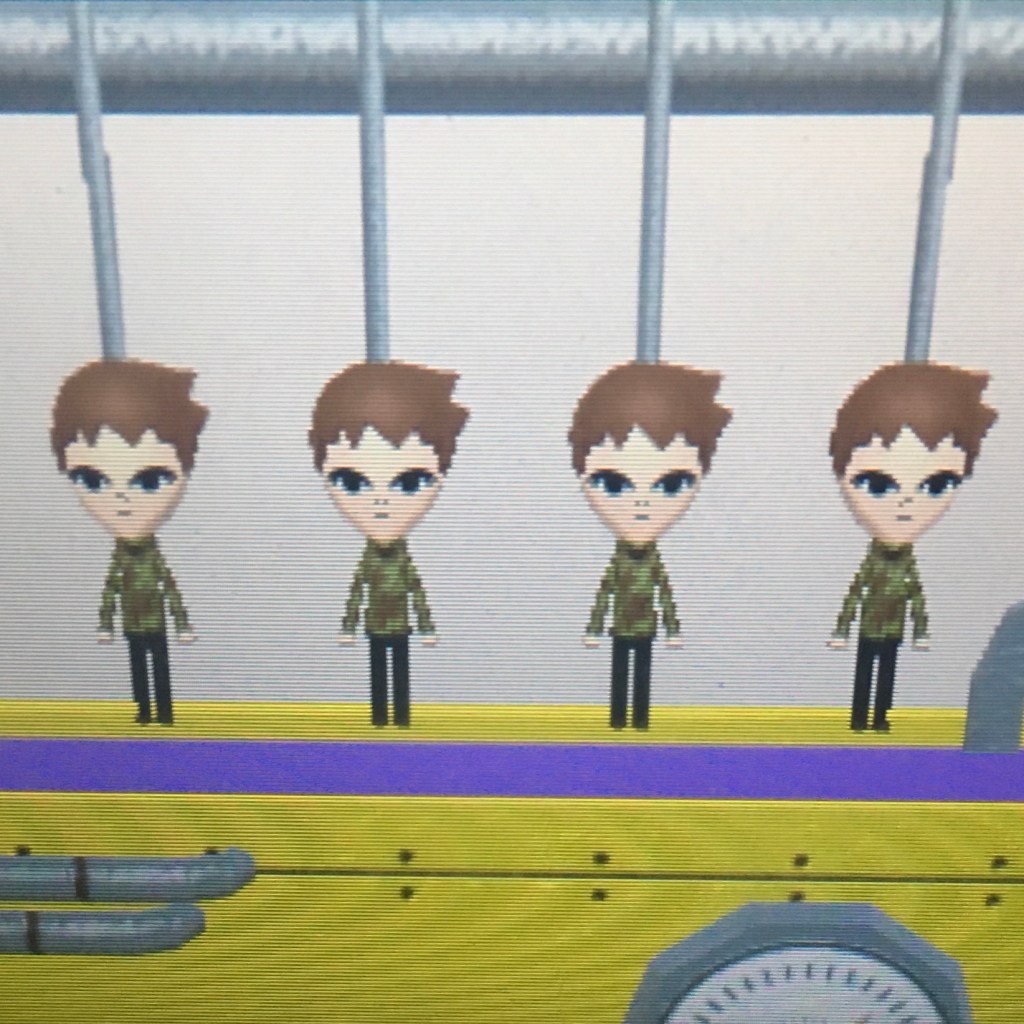
I shove fear aside to approach why I continue to draw. I learned it’s name as joy. Joy explains that artists are not machines to be broadcasted on How It’s Made, a show that plays when we are most active together. Joy notes this as my favorite show to watch as a kid, and to watch when I’m happy.
Joy adds that artists are people who enjoy things. And our artwork is akin to clay, because our efforts churn out of our hands with an unpredictable mold and texture, and we have no idea if it’ll hold up or display properly. What matters is that clay is fun to use.
In my future 12 at midnight- I’ll think about Joy, climb into bed, and realize this is okay.
Why does art suddenly grow intimidating when marked as an assignment? Can’t I chain it down and make it be mine?
My last two hours were frustratingly scattered in finding a nice glitchy overlay for my website, only to realize WordPress does not offer the feature for free. A loud click on WordPress’ HTML feature echoes in a public university library. My next seventy minutes were thoroughly baked in making HTML errors and my efforts were used to no avail.
. . . Except one. Patterns act similarly to coded software, as both require crisp alignment and setup to function properly. A rough estimate of four hours worth of software editing mirrors what visual patterns require: both require ample scrutinization and time from a human eye, and both can and will be monetized given an opportunity. A pattern may include any shape or any identifiable piece of visual information. However, the infinite ways to organize a pattern and the difficulty of choosing a sufficient one may bar users and artists.
It’s the user’s option to tail down a pattern and customize it however they see fit. A customized pattern, when tailored successfully, creates a beautiful scope for both readers and its creator to enjoy.
This requires enlightenment within an artist and for themselves to recognize fear as a barring factor in their artistic process. Our visual process often blurs the distinction between enjoyment and fear into one variable, and both largely affect how artists prepare their work. Except an artist begins with enjoyment of bleeding ink into paper, and the fear of finishing an unsatisfactory work follows shortly after. The ability to successfully distinguish fear out these two factors, and sit on it while making art amplifies an artist’s compository work.
TL;DR – Strap your fears on God’s leash and throw them away — he’ll know what to do.






 nemo
nemo 